
-
Publish Your Research/Review Articles in our High Quality Journal for just USD $99*+Taxes( *T&C Apply)
Offer Ends On
Publish Your Research/Review Articles in our High Quality Journal for just USD $99*+Taxes( *T&C Apply)
Offer Ends On
Philip L Millstein DMD, MS*
Corresponding Author: Philip L Millstein, Department of Restorative Dentistry, Harvard School of Dental Medicine, Boston, Massachusetts, USA.
Received: September 12, 2026 ; Revised: September 15, 2026 ; Accepted: September 17, 2026 ; Available Online: September 18, 2026
Citation: Millstein PL. (2026) What is the purpose of restoring occlusal contact in a dental restoration? J Oral Health Dent Res, 5(3): 1-3.
Copyrights: ©2026 Millstein PL. This is an open-access article distributed under the terms of the Creative Commons Attribution License, which permits unrestricted use, distribution, and reproduction in any medium, provided the original author and source are credited.
Views & Citations
Likes & Shares
Teeth come equipped with occlusal contacts. Dentists often ignore them. Unknown to many dentists is their purpose which is to stabilize the bite. No contact can result in an uneven bite. Occlusal failure may follow.
Keywords: Occlusion, Contact, Restorations, Wear.
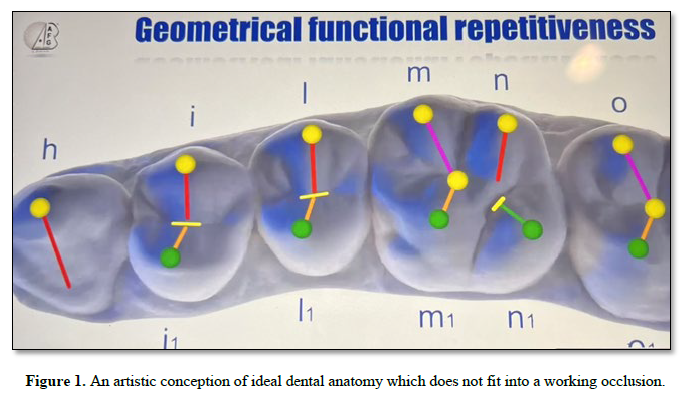
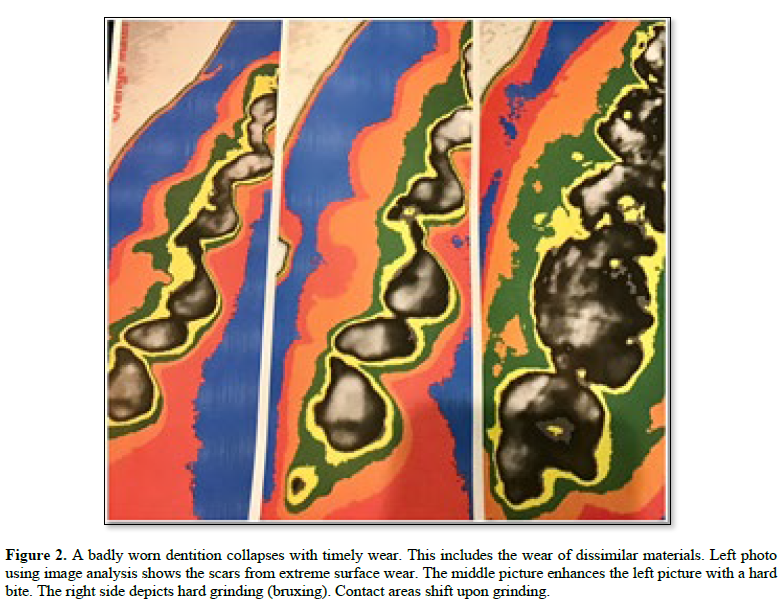
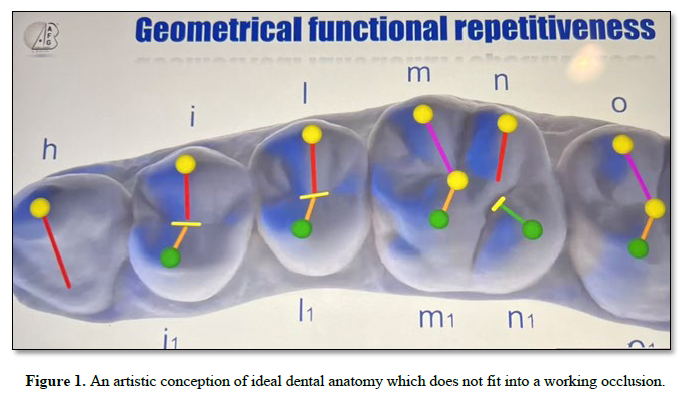
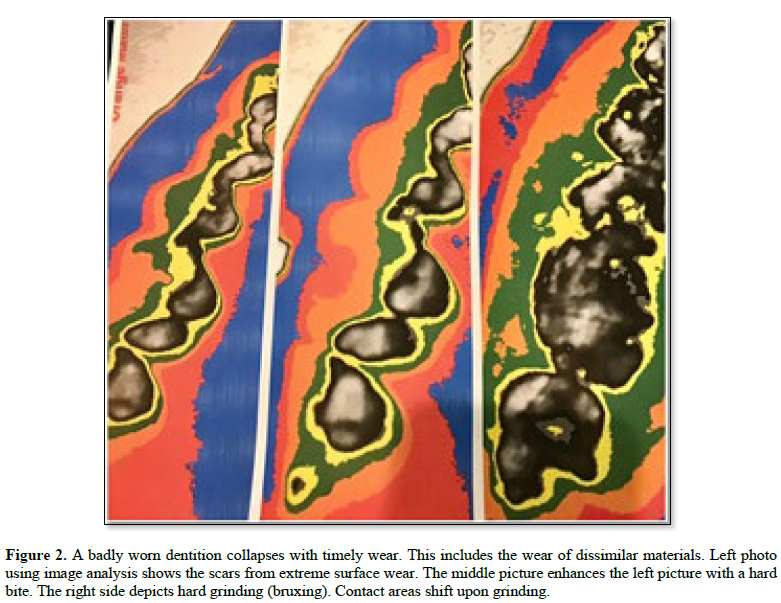
Occlusal oriented teaching highlights cusp to fossa reconstructions [1] (Figure 1). Clinically however, mandibular movement may be restricted if there is not enough cusp to fossa movement space. In restorative dentistry the occlusal contact areas of opposing teeth should fit into one another but most often they do not match. Dental articulations are difficult to capture. A restoration with a new occlusal profile requires clinical adjustments. Refinements are made. Structured jaw positions depend upon contact support. In gait analysis the orthopedist records the rhythm and intensity of joint movement as the foot encounters a flat moving platform [2]. Dentists measure mandibular movement but don’t correlate it to the intensity of occlusal and contact [3] (Figure 2).
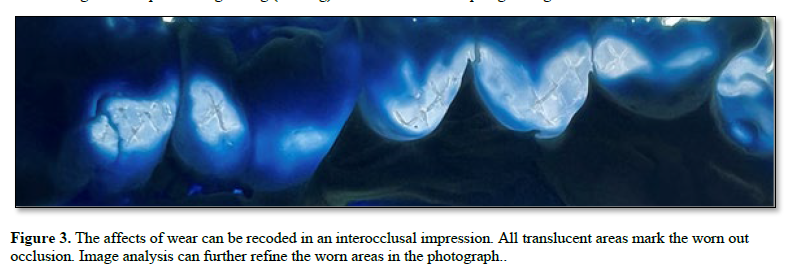
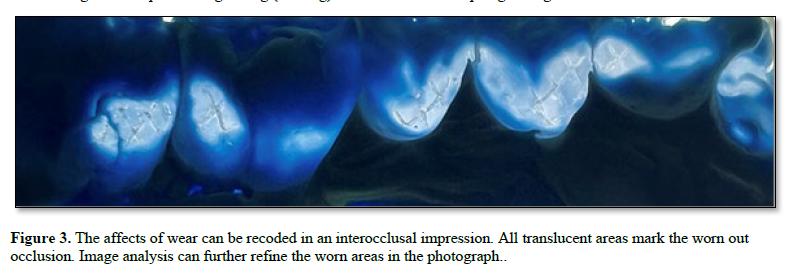
The contact surfaces are a composite of the mandibular movements. Some devices measure intensity, pressure and timing of contact in pressure or force units on an occlusal wafer [4,5]. Direct tooth to tooth contact does not occur. Tooth to tooth contact, intensity, and associated movement can be permanently recorded in an inter occlusal impression [6] (Figure 3). Imperfect occlusal contact areas cannot be restored to an ideal cusp fossa relationship. The anatomy of a new zirconia Cad Cam restoration is ideal and unworn [7]. The crown is built slightly out of occlusion to avoid contact [8]. Functional occlusal contact does not take place. Most existing dental restorations vary in material construction. Wear of dissimilar materials occurs [9].
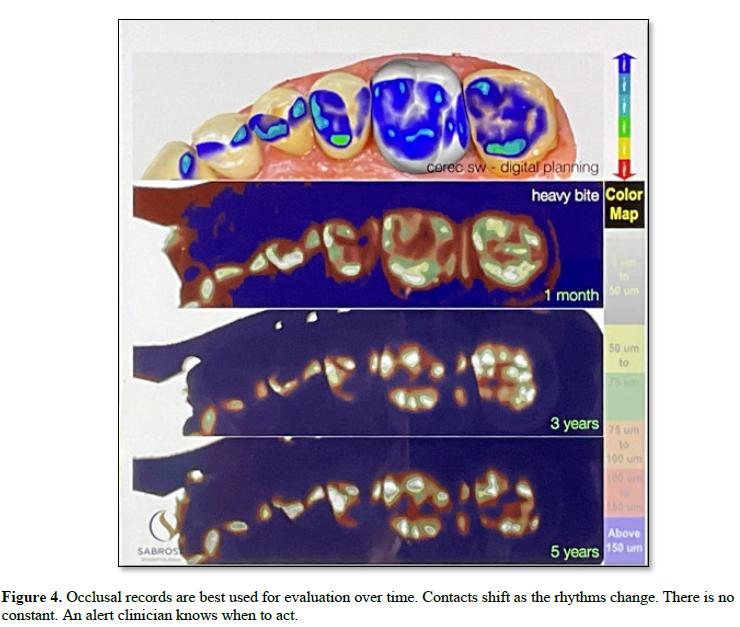
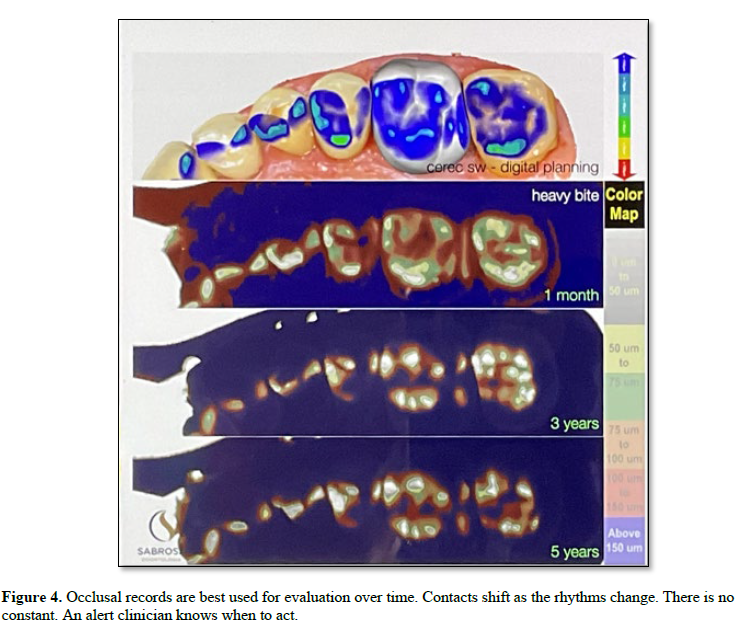
Wear patterns vary. Enamel and dentin have different wear patterns [10]. Occlusal contact varies according to contact material. Oftentimes there is no contact or contact intensity is severe. Ceramic restored implant restorations cannot sustain extreme contact intensity [11]. Gold wears best and zirconia which is hard and unyielding wears less. Ceramic is the clinicians’ choice because it is white and cost effective. In order for a restoration to function and not distort the occlusion it must make contact and become integrated into the working occlusion. The definition of a working occlusion differs for each person. Sufficient occlusal contact is required. In health or sickness the patient maintains their own balance. One poor fitting restoration can destroy a dentition. Too short a restoration and the opposing teeth must adjust. Too long and the jaw must adjust to fit the restoration. Minimal occlusal wear which includes occlusal contact becomes an important factor in maintaining occlusal health. A patient with an uneven bite continuously grinds in an attempt to even out the bite [12] (Figure 4).
A clinician must be aware of the various moments and movements of occlusal contact. There is no ideal occlusion. Schools may teach the tenets of an ideal occlusion but in practice they do not exist. Gait analysis records balance. The better the balance the better the function. A balanced occlusion is the goal towards achieving and maintaining optimal dental health. The negative impact that a misplaced contact can have on an occlusion is evident. Periodic occlusal examination is required. Occlusal contact areas and associated wear patterns should be evaluated. Past records compared (Figure 3). Clinicians can make adjustments. An occlusal contact contributes to mandibular stability. It is the point around which the occlusion functions.

No Files Found


Internationally Accepted
Share Your Publication :